
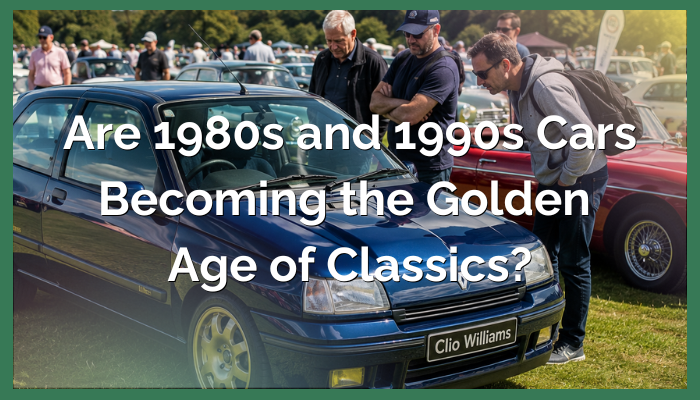
For decades, the words “classic car” conjured up a fairly predictable collection of images. An MGB on a country road, an E-Type outside a country pub, a Triumph, Austin, an old Rover or perhaps something with enough polished chrome to require its own cleaning cupboard.
But wander around a classic car show today and something is changing. Parked alongside those traditional classics you’ll increasingly find Ford Sierras, Volkswagen Golf GTIs, Peugeot 205s, BMW E30s, Volvo 240s, Toyota Supras and cars that, not all that long ago, were simply everyday traffic; and people absolutely love them.
So, are the cars of the 1980s and 1990s becoming the new golden age of classics?
The Cars We Grew Up With Are Becoming Classics
Perhaps the strangest thing about getting older is watching cars you remember being everywhere suddenly become rare enough to draw a crowd.
A Ford Sierra wouldn’t have received much attention sitting in a supermarket car park in 1994. Nor would a Vauxhall Cavalier, Volvo 240 or Rover 800. Today, find a beautifully preserved example at a classic car show and you’ll hear the stories almost immediately.
“My dad had one of those.”
“That was our family car.”
“I learned to drive in one.”
“My neighbour had the sporty version.”
That emotional connection is incredibly powerful. A classic doesn’t necessarily have to be exotic, fast or expensive to be interesting. Sometimes its appeal comes from the fact that it reminds us of a particular period in our lives.
Right now, the cars transporting an entire generation back to their childhood and teenage years are increasingly those built during the 1980s and 1990s.
Nostalgia Moves With Every Generation
The classic car market has always been driven, at least partly, by nostalgia. People naturally gravitate towards the cars they remember.
Someone growing up during the 1950s and 60s might have dreamed of owning an E-Type, Austin-Healey or Jaguar.
For somebody growing up in the 1980s, the bedroom-wall dream might instead have been a Ford Sierra RS Cosworth, Ferrari Testarossa or Porsche 911 Turbo.
Move into the 1990s and you have another generation dreaming about Subaru Imprezas, Mitsubishi Evos, Toyota Supras, Nissan Skylines and BMW M3s.
Then there were the cars we didn’t necessarily dream about but simply lived with. Cars like the family Mondeo, dad’s Cavalier, mum’s Fiesta, the Volvo estate that seemed capable of swallowing the entire contents of the house or the Peugeot 205 your friend passed their driving test in.
As the people who grew up around these cars become established enthusiasts themselves, it makes sense that the cars they want to preserve are changing too.
There is evidence of that shift in the market. Hagerty’s analysis of the UK collector car market found that its Hot Hatch and RADwood indices, covering predominantly 1980s and 1990s cars, were the only two areas showing meaningful growth during 2025.
Perhaps the definition of a desirable classic is simply moving forward with us.
The Rise of the Ordinary Classic
This might be our favourite part of the whole phenomenon. Not every car becoming collectable today had a poster dedicated to it; some were completely ordinary.
That’s precisely what makes them interesting. Think about how many Austin Maestros, Ford Orions, Vauxhall Cavaliers, Rover Metros and Renault 5s once filled British roads. Nobody thought twice about seeing them. They were driven to work, filled with shopping, used for school runs and eventually traded in when something newer came along. Then, almost without anybody noticing, they disappeared.
Suddenly finding a beautifully preserved example becomes exciting. Events such as Hagerty’s Festival of the Unexceptional have helped celebrate exactly this type of motoring history, while RADwood has created an entire celebration around cars and culture from the 1980s and 1990s.
At the 2025 RADwood event at Bicester Heritage, cars ranged from Audi Quattros and Honda NSXs to a Vauxhall Cavalier, MG Maestro Turbo and Volvo 850 T-5R. That’s a wonderfully broad definition of what deserves preservation.
It demonstrates that automotive history isn’t only written by Ferraris and Aston Martins. It’s also written by the cars millions of ordinary people actually drove.
The Hot Hatch Changed Everything
Of course, we can’t talk about the 1980s and 90s without mentioning the hot hatch. The Volkswagen Golf GTI had already helped establish the formula, but the following years gave us an extraordinary collection of small, relatively affordable performance cars.
There was the iconic Peugeot 205 GTI, Renault 5 GT Turbo, Ford Escort XR3i, Volkswagen Golf GTI, Vauxhall Astra GTE and the Ford Fiesta XR2. Later came cars such as the Renault Clio Williams and Peugeot 306 GTI-6.
These cars combined practicality with performance in a way that made exciting cars accessible to far more people; and they had personality.
Modern performance cars can deliver extraordinary levels of grip, acceleration and technology, but there’s something wonderfully simple about a lightweight hatchback, a manual gearbox and an enthusiastic engine.
Today’s market suggests enthusiasts haven’t forgotten that. Hagerty’s Hot Hatch Index remains one of the stronger-performing sections of the UK collector market.
The Sweet Spot Between Classic and Modern
There is another reason these cars are becoming increasingly appealing. For many enthusiasts, 1980s and 1990s cars occupy a fascinating middle ground. They’re old enough to feel different from modern cars but new enough to be relatively usable.
Many have fuel injection, decent heating, better brakes and more comfortable motorway manners than much older classics. Climb behind the wheel and the experience can still feel wonderfully analogue. Physical switches, manual gearboxes, hydraulic steering and relatively little electronic intervention. There’s no enormous touchscreen glowing from the dashboard, no lane assistance tugging at the steering wheel, no menu to navigate before you can change a basic setting; you just turn the key and drive.
That combination makes many modern classics particularly appealing to enthusiasts who want something with character without necessarily wanting all the compromises associated with owning a much older vehicle.
They’re Attracting Younger Enthusiasts Too
Perhaps one of the most encouraging aspects of this trend is who is buying these cars. The classic car hobby has often worried about how it will attract the next generation of enthusiasts, but the answer may already be sitting in front of us.
Hagerty’s 2026 analysis found that 92% of the owners it tracks for the Mk2 Volkswagen Golf GTI were born since 1965, giving it the youngest ownership profile of any vehicle on its 2026 Bull Market list. The Toyota Supra Mk4 also has a notably young following, with 64% of tracked owners born since 1981.
Someone in their 30s may appreciate a 1960s Jaguar, but they may have a much stronger emotional connection with a Subaru Impreza they remember from rallying, a Toyota Supra they drove on a PlayStation or the Golf GTI their parents owned.
The route into classic car ownership doesn’t have to begin with cars built before you were born. Sometimes it starts with the cars that made you fall in love with motoring in the first place.
Does a Classic Even Need to Be Valuable?
This is where things become interesting. The classic car world can sometimes become a little obsessed with values.
What is it worth?
Is it appreciating?
How much did that one make at auction?
But value and significance aren’t necessarily the same thing. A pristine 1992 Ford Fiesta might be worth considerably less than an exotic sports car but put one at a show and it could generate far more conversation. Why? Because people have stories attached to it.
Perhaps that’s one of the nicest things about the growing appreciation for 1980s and 1990s cars. It reminds us that classic cars don’t have to be investments, they can simply be cars worth saving.
So, Were the 1980s and 1990s a Golden Age?
Ask ten enthusiasts and you’ll probably get eleven answers. Fans of the 1960s might point towards beautiful styling, lightweight sports cars and some of Britain’s greatest motoring icons.
Fans of the 1970s have plenty to argue back with, but the 1980s and 1990s gave us something different. Hot hatches, homologation specials, turbocharging, Japanese performance cars, outrageous supercars and ordinary family cars that now carry an enormous amount of nostalgia.
The enthusiasm surrounding them isn’t imaginary either. Hagerty’s market analysis shows that 1980s and 1990s collector cars have remained comparatively resilient while many older sections of the UK classic market have softened.
Perhaps calling any particular decade the “golden age” misses the point though. The golden age of classic cars isn’t fixed, it moves. Every generation eventually looks back at the cars that filled its roads, television screens, driveways and bedroom walls and realises something rather alarming. They’ve disappeared, and suddenly we want them back.
So perhaps the next great classic isn’t an exotic supercar sitting in a collection somewhere. Perhaps it’s an ordinary car from your childhood that nobody thought to save.
So, here’s a question for you. If you could save just ONE car from the 1980s or 1990s from disappearing forever, what would it be?




Leave A Comment