
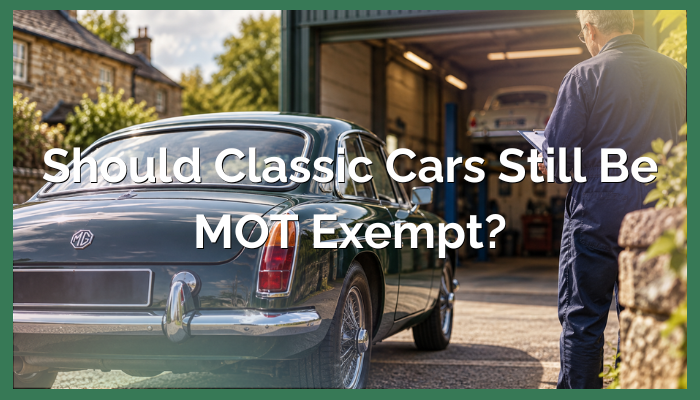
If you own a classic car that’s more than 40 years old, there’s a good chance you no longer need to take it for an annual MOT. For some owners, that’s a welcome recognition that cherished historic vehicles are generally maintained very differently from everyday cars. For others, the idea that a car that’s four, five or even six decades old can legally take to the road without an annual independent inspection doesn’t sit quite so comfortably.
It’s a debate that’s been brought back into focus by new research from Hagerty UK.
More than 1,200 drivers were surveyed, around 90% of whom currently own a classic vehicle. While 61% believed the existing MOT exemption was a good thing, 64% said they’d support a special MOT-style test designed specifically for classic cars. Perhaps more strikingly, 69% believed the current exemption makes it more likely that unroadworthy classics will remain in use.
So, should the current system stay exactly as it is, should annual MOTs return or is there another option altogether?
What Does MOT Exemption Actually Mean for a Classic Car?
First, it’s worth clearing up exactly what the exemption means because an MOT-exempt classic isn’t simply free from any responsibility regarding its condition.
Under the current rules in England, Scotland and Wales, a vehicle generally doesn’t require an MOT if it was built or first registered more than 40 years ago and hasn’t undergone substantial changes during the previous 30 years. Owners still have to tax the vehicle, even where no Vehicle Excise Duty is payable, and declare that it meets the exemption requirements.
Most importantly, the vehicle must still be roadworthy.
The Government makes this very clear. Driving a vehicle in a dangerous condition can result in a fine of up to £2,500 and three penalty points, regardless of whether that vehicle requires an MOT.
There’s also nothing preventing an owner from having an MOT voluntarily. In fact, plenty already do.
You can read the current Government guidance on historic vehicle MOT exemptions.
Why Were Classic Cars Made MOT Exempt in the First Place?
The current rolling 40-year exemption was introduced in May 2018. Before that change, MOT exemption generally applied to vehicles manufactured before 1960.
The reasoning wasn’t simply that old cars no longer needed checking.
When the Government consulted on roadworthiness testing for historic vehicles, it considered how these cars are typically used, their historic nature and whether the modern MOT remained appropriate for vehicles designed to very different standards.
The consultation received 2,217 responses from owners, clubs, businesses, trade organisations and public bodies before the Government decided to introduce the rolling exemption.
There’s an important distinction here.
A classic car that’s covering a relatively small annual mileage, being maintained by an enthusiastic owner and spending much of its life safely stored isn’t necessarily comparable with a 15-year-old everyday car covering thousands of miles every year.
That difference forms much of the argument for retaining the exemption.
You can read the Government’s original consultation and response.
The Argument for Bringing Back an Annual MOT
The strongest argument for some form of annual inspection is also the simplest.
None of us can see everything.
You might know every noise your classic makes and spend more time underneath it than behind the wheel, but another pair of experienced eyes can still spot something you’ve missed.
Brake deterioration, corrosion, steering components, suspension wear and tyre problems don’t necessarily announce themselves dramatically. Some issues develop slowly enough that an owner who’s familiar with the car may not immediately notice the change.
That’s where the latest Hagerty research becomes particularly interesting.
Of the more than 1,200 drivers surveyed, 69% believed the exemption could result in more unroadworthy classic vehicles being used on the road, while 21% said they’d personally seen an unroadworthy classic being driven.
Perhaps even more revealing is what owners are already choosing to do.
43% of owners with an MOT-exempt vehicle said they still put it through an MOT every year.
The MOT also appears to matter when people buy classics. 43% of respondents said they’d pay more for an MOT-exempt vehicle if it nevertheless had a valid MOT, while 47% believed mandatory testing could help preserve classic vehicles for future generations.
You can read more about the Hagerty UK survey and its findings here.
For supporters of annual testing, the argument isn’t necessarily that classic owners are irresponsible. It’s that an independent inspection provides reassurance for the owner, future buyers and everybody else sharing the road.
Are Classic Car Owners Already More Careful Than Most?
There is, however, another side to that argument.
Classic cars aren’t generally treated like ordinary transport.
For many owners, checking fluid levels, brakes, tyres and mechanical components isn’t something that happens once a year before an MOT. It’s simply part of owning the car.
A strange noise gets investigated. A small leak gets noticed. The car might be inspected before a long journey or given a thorough check when it comes out of winter storage.
The Hagerty research actually provides some support for this side of the debate too.
While 64% of respondents would welcome a classic-specific test, 61% still said the existing MOT exemption was a good thing. Among owners who don’t voluntarily MOT their exempt vehicle, an overwhelming 98% said they maintain it to a standard at which they believe it would pass one anyway.
That doesn’t prove every exempt classic is roadworthy, of course. Equally, having an MOT certificate doesn’t guarantee a vehicle will remain roadworthy for the following 12 months.
The Historic & Classic Vehicles Alliance currently recommends regular safety checks for MOT-exempt vehicles, either through a historic vehicle specialist or an optional MOT. It particularly recommends checks when a vehicle returns to use following a period off the road or after restoration.
You can read the HCVA’s guidance on MOTs and substantially changed historic vehicles.
So perhaps the question isn’t whether responsible owners maintain their classics. Most clearly do.
It’s what happens to the ones that aren’t being maintained quite so carefully.
Is a Modern MOT Really the Right Test for a 50-Year-Old Car?
This is where the argument becomes more complicated.
Putting a 1970s Rover through exactly the same basic testing framework as a modern family car isn’t necessarily straightforward.
Vehicle design has changed enormously over the past half-century. Steering systems, braking technology, suspension, lighting and countless other components have evolved.
The Government’s own MOT inspection manual acknowledges this. Testers are specifically reminded that components on historic vehicles may have been manufactured with a greater degree of play or tolerance than would be found on modern vehicles.
An experienced tester who understands classics will recognise that.
Someone who rarely sees anything older than a 15-year-old hatchback might understandably have less familiarity with what’s normal for a car built several decades earlier.
This is one reason the HCVA has argued in favour of an optional, industry-led roadworthiness test for historic vehicles rather than simply assuming the existing MOT is the perfect solution.
You can see the HCVA’s position on historic vehicle roadworthiness testing here.
What About Classics That Spend Months in the Garage?
There’s another problem with relying entirely on either an annual MOT or owner maintenance.
Classic cars often spend long periods standing still.
A vehicle could pass an MOT, cover very few miles and then spend several months tucked away before returning to the road. During that period batteries can deteriorate, brakes can bind, tyres can lose pressure, rubber components can age and fluids can leak.
An MOT certificate tells you that the vehicle met the required standard at the time it was tested. It isn’t a guarantee that everything will remain perfect until the next test.
The same argument works in the opposite direction.
An MOT-exempt classic that’s regularly inspected, properly maintained and checked before every significant journey could potentially receive far more attention than an everyday car whose owner thinks about its condition only when the annual MOT reminder arrives.
Perhaps roadworthiness has as much to do with the culture of maintenance as it does with the test itself.
Would a Classic-Specific Safety Test Be a Better Compromise?
This may be where the latest Hagerty findings become most interesting.
The choice doesn’t necessarily have to be between compulsory annual MOTs and no formal inspection whatsoever.
64% of the drivers surveyed said they’d welcome a special MOT designed specifically for classic vehicles.
That could potentially mean an inspection carried out by somebody familiar with historic vehicles, assessing safety and roadworthiness while recognising the engineering standards and characteristics of the period.
It could also provide owners with independent reassurance without trying to judge a 50-year-old vehicle entirely through the expectations we place on modern cars.
There would still be questions to answer.
How often should the inspection take place? Who would be qualified to carry it out? Would it be compulsory or voluntary? What would it cost? How would modified classics be treated?
Those details matter.
However, the Hagerty results suggest there’s an appetite among classic owners for a conversation about something between the two extremes.
Interestingly, Hagerty’s survey found that while 61% support the existing exemption, 64% would also welcome a dedicated classic test.
Those figures might initially appear contradictory.
Perhaps they’re not.
Maybe many classic owners aren’t saying, “Don’t inspect our cars.”
Perhaps they’re saying, “Inspect them appropriately.”
So, Should Classic Cars Still Be MOT Exempt?
There are reasonable arguments on both sides.
The current exemption recognises that historic vehicles are different from everyday transport and that many are maintained carefully by knowledgeable owners who cover relatively few miles.
Compulsory testing, however, introduces an independent check that may catch problems an owner hasn’t noticed and provides additional reassurance when a classic changes hands.
Then there’s the third option.
Rather than bringing every historic vehicle back into the standard MOT system, perhaps a dedicated classic vehicle safety inspection could provide a middle ground.
The latest survey suggests plenty of owners would consider it.
But we’d much rather hear from the people actually owning, maintaining and driving these cars.
If your classic is MOT exempt, do you still put it through a voluntary MOT each year?
Would you bring back compulsory annual testing, keep the current exemption exactly as it is or introduce a separate safety inspection specifically for historic vehicles?
And if you’ve owned an MOT-exempt classic for several years, has the exemption changed the way you maintain it at all?
Let us know what you think in the comments. We suspect there are going to be some very different opinions on this one.






Leave A Comment