
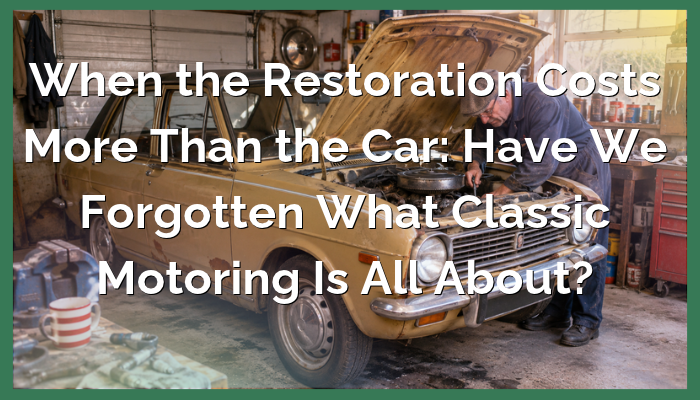
Imagine finding the exact model of car your dad used to drive. It’s the same colour, has the same interior and even has that familiar smell you remember from childhood. It’s been sitting in a garage for the best part of 20 years and needs considerably more than a little TLC.
You know it’ll cost more to restore than it’ll ever be worth, but there’s something about it that makes walking away incredibly difficult, do you listen to your head or your heart?
It’s a dilemma that many classic car enthusiasts will recognise. In an age where auction results, rising values and investment potential dominate so many conversations about classic motoring, it’s easy to forget that not every car was bought with the intention of turning a profit.
Our recent social media posts featuring vintage classified ads have reminded us just how much affection there still is for the ordinary cars that once filled Britain’s roads. A £295 Ford Cortina, a £395 Austin Maestro or a Volvo 340 might not have turned many heads back in the early 1990s, yet today they bring back so many memories for an entire generation.
When the cost of classic car restoration exceeds the finished value of the vehicle, does that really mean it isn’t worth saving? Or have we become a little too concerned with what our classics are worth rather than what they mean to us?
When Did Classic Car Restoration Become All About the Money?
Spend any amount of time reading classic car magazines, browsing online forums or following auction results and you’ll notice how frequently the conversation turns to money.
We’re constantly being told which cars are increasing in value, which models could be the next big investment and which classics we should buy before prices start to climb. There’s nothing wrong with taking an interest in the market, particularly when you’ve invested a considerable amount of money in a car yourself.
However, when did financial return become the most important part of a hobby that’s traditionally been driven by passion?
Think back to when you first became interested in cars. Perhaps you spent your weekends helping your dad in the garage, flicking through the motoring classifieds or saving every penny towards your first car. You probably weren’t calculating its potential resale value in ten years’ time. You simply wanted to own it, drive it and enjoy the freedom that came with it.
For many enthusiasts, classic car restoration is an opportunity to experience those feelings again. Whether it’s recreating the first car they owned or finally buying the model they couldn’t afford in their twenties, the motivation often has very little to do with making money.
Perhaps we’ve become so accustomed to measuring the success of a restoration by the finished value of the car that we’ve overlooked some of the other reasons for undertaking one.
The Reality of Classic Car Restoration Costs
Of course, there’s no getting away from the financial realities of restoring an older vehicle. What begins as an affordable project can quickly become something considerably more expensive, particularly once you start discovering what’s lurking beneath the paintwork.
A small patch of visible rust could conceal extensive corrosion, while an engine that supposedly ran when parked might require a complete rebuild. Replacement panels, paintwork, upholstery, chrome plating and specialist labour can all add thousands of pounds to the overall cost.
According to a 2026 classic car restoration cost guide from Direct Classics, published specialist workshop rates range from £62 to £95 per hour plus VAT, with some specialist fabrication work costing even more. A comprehensive professional restoration could cost anywhere between £30,000 and £100,000 or more, depending on the vehicle and the work required.
Let’s imagine you’ve bought an ordinary classic for £2,000 and spent a further £15,000 restoring it. You’ve now invested £17,000 in a car that might only have a market value of £6,000. On paper, you’ve made a considerable financial loss.
It’s something Hagerty explored in its article examining which classic cars are worth restoring, comparing the differences between the values of cars in various conditions and considering whether those differences could justify restoration expenditure.
From a purely financial perspective, buying an already restored example can often make considerably more sense than starting from scratch. That doesn’t necessarily mean it’ll provide the same level of satisfaction, particularly if the restoration itself was something you always wanted to experience.
The question is whether you’re buying the finished car or the journey that gets you there.
How Do You Put a Price on a Childhood Memory?
There’s something remarkable about the way an old car can transport you back in time without moving an inch.
Opening the door and catching the familiar smell of an old vinyl interior might remind you of sitting in the back of your parents’ car. The sound of an engine turning over could take you straight back to Sunday mornings spent helping your dad in the garage, passing him spanners and pretending you understood exactly what he was doing.
Perhaps it’s the Ford Sierra that took your family on holiday, the Austin Mini you passed your driving test in or the Vauxhall Cavalier you owned when you first met your other half. For some enthusiasts, restoring a classic car is about reconnecting with a part of their life that they can’t return to any other way.
Imagine inheriting your father’s old car. It’s been sitting in the garage for years, the paintworks faded and there are mechanical jobs that would cost thousands to put right. Someone might advise you to sell it and buy a better example for considerably less money. The trouble is that another example isn’t your dad’s car.
It doesn’t have the same worn steering wheel, the same little marks on the dashboard or the same history. It might be identical in specification, but it could never mean quite the same thing.
For someone in that position, spending more than the car is financially worth might not feel unreasonable at all. After all, how do you put a price on something that makes you feel a little closer to someone who’s no longer here?
Don’t Ordinary Classic Cars Deserve to Be Saved Too?
There’s understandably plenty of admiration for beautifully restored Jaguar E-Types, Aston Martins and Ferraris. These cars represent extraordinary periods of automotive design and engineering, and their values can sometimes make extensive professional restorations financially viable.
What about the cars that don’t command those sorts of prices though? The Austin Maestro, Morris Marina, Vauxhall Cavalier and countless other everyday family cars were once an ordinary part of British life. Nobody thought much about preserving them because there always seemed to be another one around the corner.
Gradually, they became older, cheaper and increasingly disposable. Mechanical problems or corrosion would eventually result in many being sent to the scrapyard because repairing them simply wasn’t worthwhile.
Decades later, we’re beginning to appreciate just how much of our everyday motoring history has disappeared. The popularity of Hagerty’s Festival of the Unexceptional, an event celebrating the once commonplace cars that are now increasingly unusual sights, demonstrates that automotive enthusiasm extends well beyond exotic sports cars and prestigious marques.
There’s a certain irony in seeing crowds gather around a beautifully preserved family hatchback that would barely have attracted a second glance when it was new. If every classic car restoration had to make financial sense, how many of these ordinary cars would survive?
It would be a great shame if future generations could see wonderful examples of the cars that wealthy people drove but had very little opportunity to experience the vehicles that millions of ordinary British families relied upon.
Their contribution to our motoring history is every bit as worthy of recognition.
Is the Restoration Itself Part of the Enjoyment?
For many enthusiasts, owning a classic car is only half the hobby. The other half takes place in the garage, often accompanied by a radio, a cup of tea that’s gone cold and the occasional choice word directed at a stubborn bolt.
There’s a tremendous sense of achievement in bringing something back to life with your own hands. Whether it’s rebuilding a carburettor, finding an electrical fault that’s been causing problems for months or hearing an engine fire up for the first time in years, those little victories are part of the experience.
Even the search for parts can become an adventure. A morning spent wandering around an autojumble might finally uncover that elusive piece of trim you’ve been looking for. Along the way, you’ll probably have several conversations with complete strangers who share your enthusiasm for a particular car.
Restoration projects can also bring generations together. A father and son rebuilding an old Mini or a grandparent teaching their grandchildren how to carry out basic mechanical repairs are creating memories that extend far beyond the finished vehicle. They’re also passing on practical knowledge and skills that might otherwise be lost.
We rarely expect other hobbies to provide a financial return. People spend thousands of pounds over the years on fishing, golf, holidays and countless other interests without expecting to recover every penny. Why should classic car restoration necessarily be any different?
If a project provides years of enjoyment, teaches you new skills and introduces you to lifelong friends, perhaps some of its value has already been realised long before the car returns to the road.
Does Every Classic Car Really Need a Full Restoration?
One of the challenges facing classic car restoration is the perception that a finished vehicle needs to look as though it’s just rolled out of the showroom.
There’s something undeniably impressive about a concours-standard restoration, but achieving that level of finish comes at a considerable cost. For an ordinary classic with a relatively modest market value, it might also be completely unnecessary.
A mechanically sound car with slightly faded paintwork, a worn interior and a few age-related imperfections can still provide an enormous amount of enjoyment. In fact, those imperfections often contribute to its character.
An original driver’s seat that’s been worn down over decades of use tells a story that a newly upholstered replacement can’t. A slightly faded dashboard or a small mark left by a previous owner is part of the car’s individual history.
There’s also something to be said for a rolling restoration, where an owner gradually improves their classic while continuing to drive and enjoy it whenever it’s safe and roadworthy to do so.
Prioritising structural integrity, brakes, steering and mechanical reliability over cosmetic perfection can make classic ownership considerably more achievable. It might also encourage more enthusiasts to take on projects that would otherwise be considered financially unviable.
Not every classic car needs to win trophies, attract attention at an auction or have a flawless finish. Sometimes, simply getting it back on the road is an achievement worth celebrating.
Would You Restore a Classic Car Knowing You’d Never Get Your Money Back?
There’s nothing wrong with approaching classic car restoration with a sensible budget and an understanding of what the finished vehicle might be worth. An abandoned project sitting in the garage because the money has run out is unlikely to bring anybody much enjoyment.
However, there’s a difference between making a financially informed decision and expecting every decision to make financial sense.
For some enthusiasts, buying an already restored classic will be the right choice. Others will happily spend years rebuilding a car despite knowing they’ll never recover what they’ve invested. Neither approach is wrong.
One day, somebody might stand beside a lovingly restored Ford Cortina at a classic car show and say, “My dad had one of those.” They might spend the next ten minutes telling the owner about childhood holidays, trips to the seaside and how they remember sitting in the back with their siblings, arguing over who got to sit by the window. For a few moments, that ordinary old Ford has brought back memories they might not have thought about for years.
Nobody’s thinking about auction estimates, restoration invoices or how much the owner would get if they sold it tomorrow. Perhaps that’s what classic motoring is really all about. Not every classic car is worth restoring financially, but that doesn’t mean it isn’t worth saving.
We’d love to hear your thoughts and, more importantly, your stories.
Have you ever spent more restoring a classic car than it was worth, and would you do it all over again?
Is there a car you’d never sell, regardless of how much somebody offered you, because of the memories attached to it?
If money were no object and you could bring just one car from your past back to life, which would it be and why?
Let us know in the comments.


Leave A Comment